
1949 Penny Value Can Change Dramatically by Grade
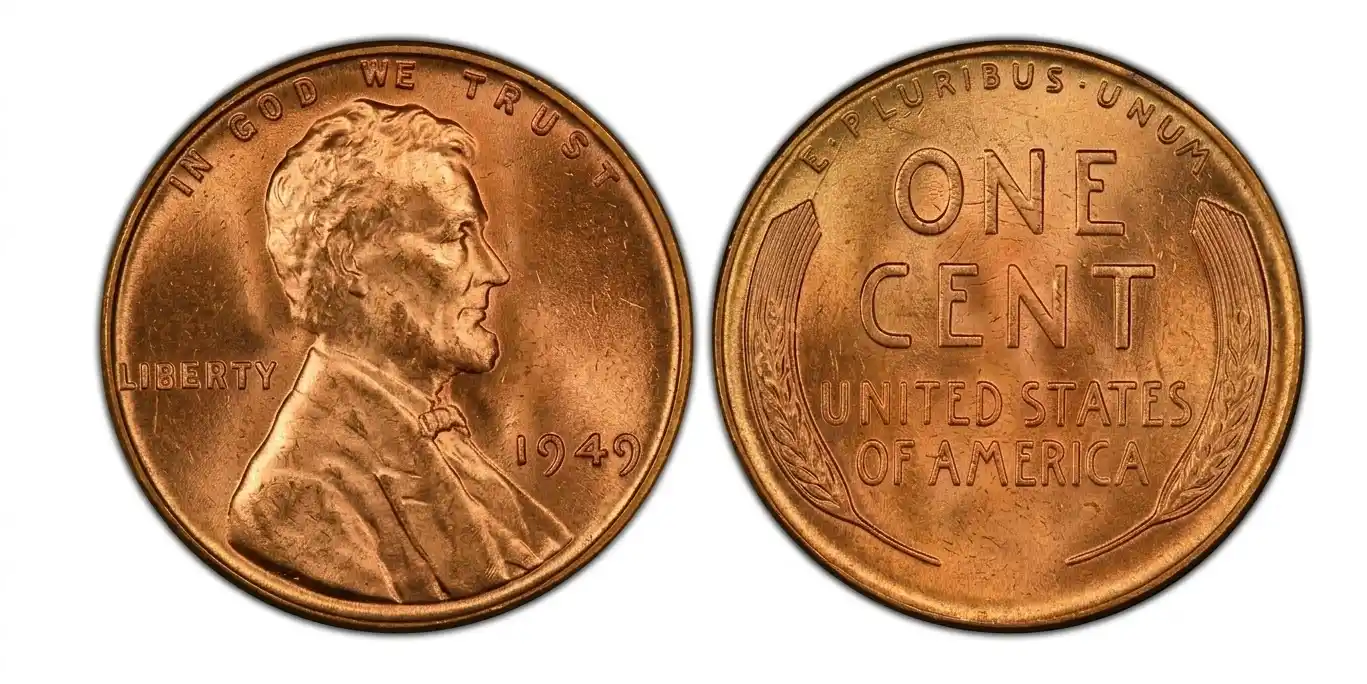
Lightly circulated coins and fully preserved examples belong to completely different price ranges.
Grading determines the market position of every specific specimen.
A numismatic 1949 penny value results from combining rarity with visual characteristics.
Investors rely on professional grading service data for valuation.
Parameter | Value |
Composition | 95% copper plus 5% tin and zinc |
Mass | 3.11 grams |
Diameter | 19.05 millimeters |
Edge Type | Plain |
Designer | Victor David Brenner |
Mint Variety Analysis
Each production facility released a specific volume of currency.
Mint marks appear under the date on the obverse side.
Absence of a mark indicates Philadelphia production.
Letter D represents the Denver facility.
Symbol S signifies San Francisco manufacturing.
1949 Philadelphia No Mint Mark Production
Total mintage reached 217,825,000 units.
Coins lacking mint marks appear more frequently than other varieties.
Specimens in Brown condition represent the most affordable category.
Transitioning to Red Brown status increases buyer interest significantly.
Red category represents the highest level of copper preservation.
Price dynamics for MS66 Red grade:
2022 price: $45.00 per unit
2023 price: $52.00 per unit
2024 price: $60.00 per unit
2025 price: $68.00 per unit
2026 price: $75.00 per unit
1949-D Denver Production
Denver minted 153,132,000 units.
Striking quality in Denver during this period shows high detail.
Finding coins retaining full original luster presents challenges.
Heritage Auctions records show significant final bids for top specimens.
Selling an MS67+ Red specimen generated high returns for the owner.
Investment appeal for 1949-D:
Demand stability
Market liquidity
Slow value growth for rare grades
1949-S San Francisco Production
Lowest mintage in the series totaled 64,290,000 units.
Traditionally S-marked coins carry higher premiums due to lower production volume.
Many 1949-S specimens preserved bright red coloration.
Abrupt price changes occur when moving from MS66 to MS67 status for this position.
Price statistics for 1949-S MS67 Red:
2024 price: $190.00 per unit
2025 price: $215.00 per unit
2026 price: $240.00 per unit
Grading Impact on Market Valuation
Sheldon scale divides coins into 70 distinct levels.
Every point increase reflects improved surface conditions.
Presence of small scratches reduces the final grade.
Absence of wear on Lincoln hair remains a critical factor.
1949 coinage rarely yields specimens exceeding MS67.
Grade | 1949 Philadelphia | 1949-D Denver | 1949-S San Francisco |
MS63 Red | $8.00 | $7.00 | $12.00 |
MS64 Red | $15.00 | $12.00 | $20.00 |
MS65 Red | $30.00 | $25.00 | $45.00 |
MS66 Red | $65.00 | $55.00 | $95.00 |
MS67 Red | $450.00 | $375.00 | $650.00 |
Copper Color as a Valuation Factor
Professional Coin Grading Service classification divides copper coins into three types.
Surface color depends directly on storage environments.
Oxidation begins immediately upon metal contact with oxygen.
Brown BN
Coins lost over 95% of original red color.
Surfaces acquired chocolate or dark shades.
Value for such specimens remains minimal.
Exceptions occur only for rare minting errors.
Red Brown RB
Preservation of red color ranges from 5% to 95%.
Such coins demonstrate partial luster.
Market price sits in the middle range.
Buyers view these as budget alternatives to the Red category.
Red RD
Gaining this status requires preserving over 95% of natural color.
Bright orange-red luster is mandatory.
Any darkening removes the coin from this designation.
Value difference between RB and RD for MS66:
Grade MS66 RB price: $25.00
Grade MS66 RD price: $65.00
Value growth → 160%
Minting Errors and Profitability
Numismatic defects create unique specimens.
Investors pay premiums for production anomalies.
Demand for errors remains consistently high.
Double Die
Doubling of design elements occurs during the hubbing process.
Typically this involves letters or date digits.
No major Double Die Obverse varieties exist for 1949.
Minor variations requiring Coin ID Scanner exist in the market.
Off-Center Strike
Planchet misalignment relative to the die results in incomplete images.
Worth depends on the percentage of misalignment.
Presence of a full date on the coin increases its price.
10% off-center → price $25.00
50% off-center → price $150.00
Off-center with full date → price $300.00
Die Crack
Cracks in the steel die leave raised lines on the coin surface.
Most often these appear on the reverse near wheat stalks.
Small cracks barely affect the final price.
Large die breaks command higher valuations.
Repunched Mint Mark
Secondary application of the mint mark creates a shadow effect.
This frequently appears on 1949-D and 1949-S issues.
Minimal deviation brings a small price premium.
Clear overlapping letters make the coin highly desirable.
Auction Record Analysis
High transaction results occur for exceptional specimens.
Professional certification is a mandatory condition for expensive deals.
Absence of certificates reduces buyer confidence.
Auction record for 1949-D in MS67+ Red:
Sale price: $7,500.00
Transaction date: January 2018
Auction record for 1949-S in MS67 Red:
Sale price: $4,300.00
Transaction date: August 2015
Price trends for top grades:
2020: supply volume decrease
2022: increased interest in MS67 condition
2024: price consolidation at high levels
Preservation Factors and Storage Conditions
External environments negatively affect copper metal.
High humidity triggers corrosion.
Contact with fingers leaves greasy stains.
Chemical reactions change surface structure forever.
Protection Methods
Use of plastic capsules
Humidity control in storage rooms
Rejection of coin cleaning
Application of specialized albums
Professional Certification Process
Third-party companies provide objective assessments.
Evaluators verify authenticity and condition.
Results remain fixed in a sealed holder.
Grading Stages
Order reception and registration
Visual inspection with the coin app
Numerical value assignment
Color category determination
Specimen encapsulation
Comparison with Adjacent Issues
Mintage figures in the 1940s show massive scales.
1949 sits in the middle of the decade.
Value compared to 1948 and 1950 shows similar numbers.
However 1949-S stands out from the general background.
Mintage differences for San Francisco:
1948-S → 64,841,000 units
1949-S → 64,290,000 units
1950-S → 118,505,000 units
Lower quantities of 1949-S create long-term potential.
Detailed Obverse and Reverse Description
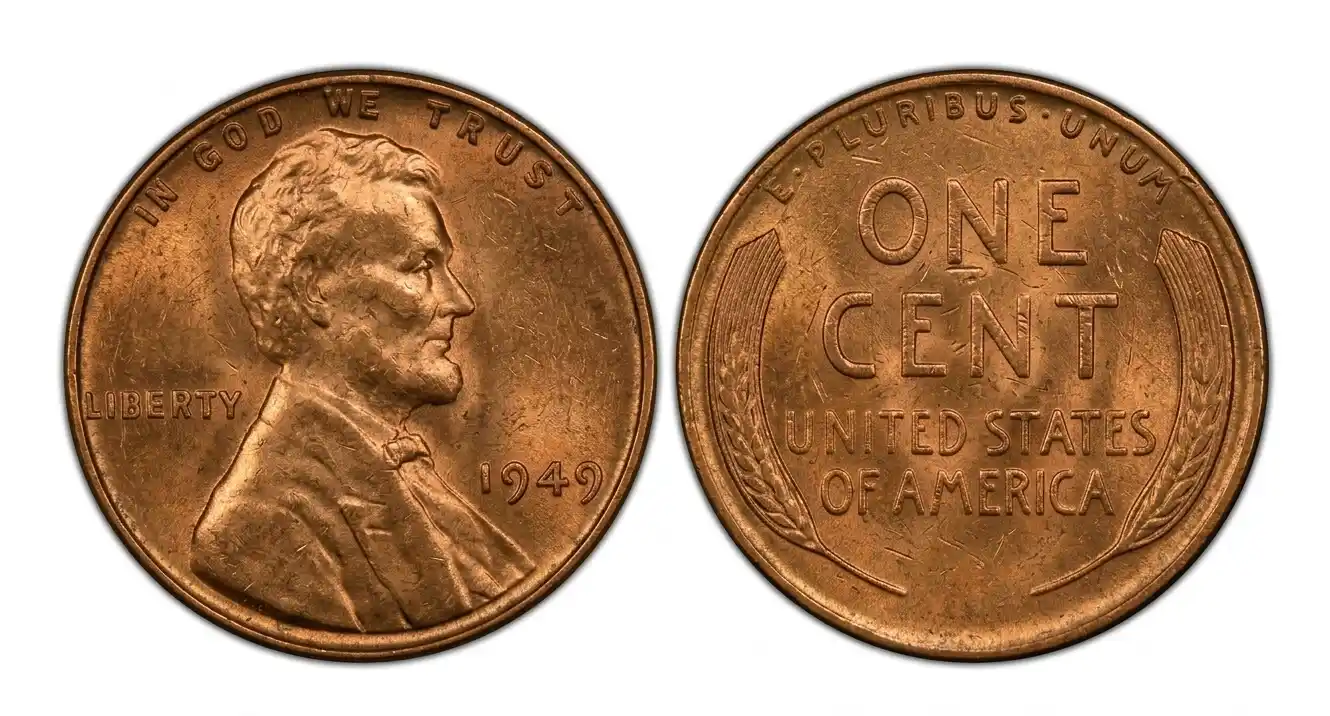
Lincoln design remains unchanged since 1909.
Obverse features the portrait of the 16th US President.
Inscriptions IN GOD WE TRUST and LIBERTY are mandatory.
Date sits in the right field area.
Reverse features two wheat stalks.
Text ONE CENT and UNITED STATES OF AMERICA occupies the center.
Motto E PLURIBUS UNUM sits at the top.
Condition of wheat stalks often determines the coin grade.
Wear on grain tips indicates circulation.
Full line definition on stalks characterizes MS65 and higher grades.
Long-Term Investment Potential
Copper pennies represent an affordable entry point into numismatics.
Massive 1949 production limits price growth for average grades.
Main potential focuses on the MS67 category.
Finding such coins in general circulation is impossible.
They originate from unsealed bank rolls.
Probability of finding rare specimens in pocket change equals zero.
Value changes over time:
Last 10 years → 15-20% growth for MS66
Future 5 years → expected 10% growth for MS67
US market remains the primary consumer for these coins.
Final Evaluation Recommendations
Self-evaluation requires experience and specialized tools.
Using 10x magnification helps see hidden defects.
Comparing with reference images increases accuracy.
Remembering differences between mint luster and artificial cleaning is vital.
Cleaned coins lose up to 90% of numismatic value.
They receive a Details label instead of a numeric grade.
Selling such positions presents difficulties.
Buyers prefer original patina.